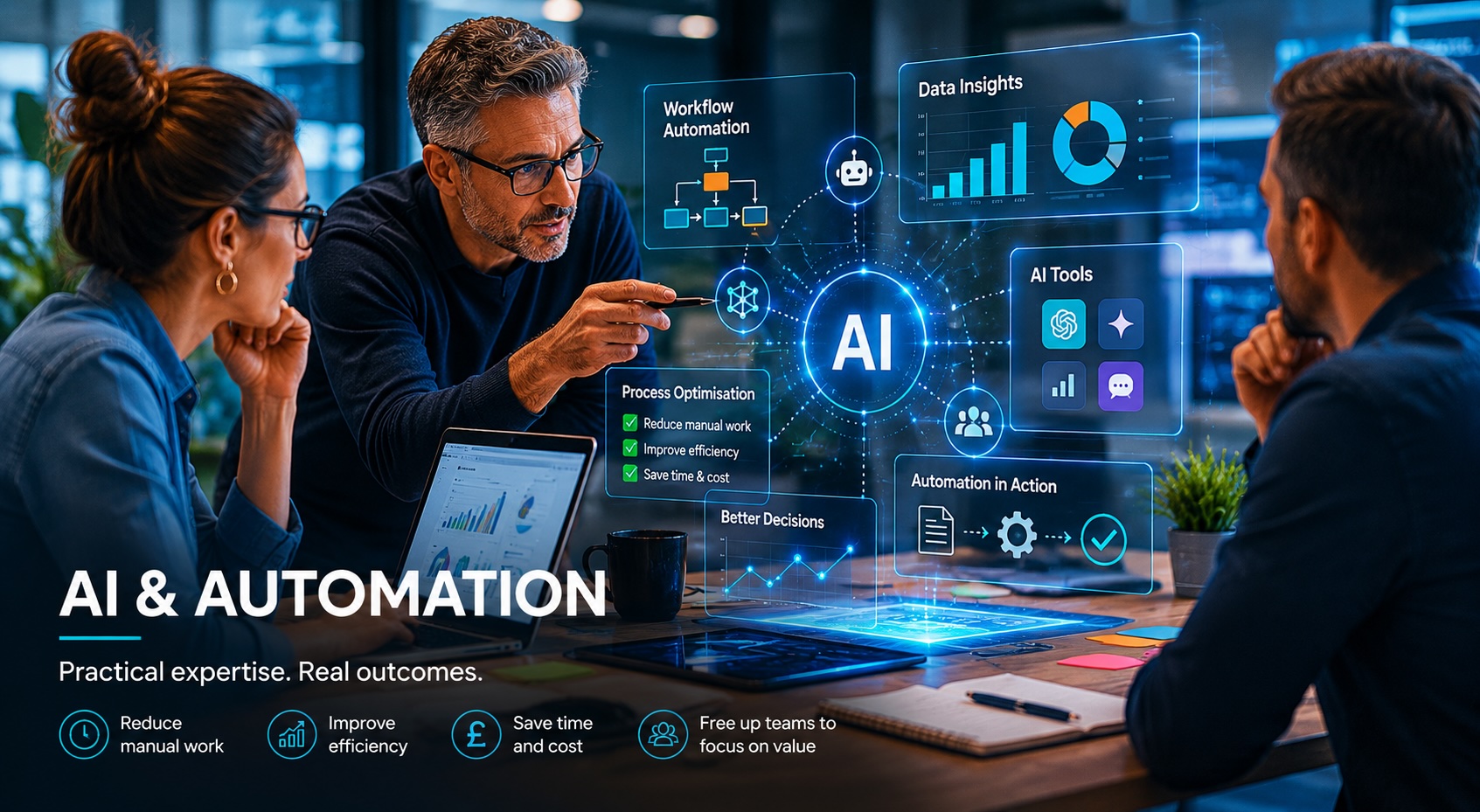
How experienced AI and automation specialists help businesses move from experimentation to real-world results.
One of the biggest advantages of flexible expertise is the ability to bring highly specialised knowledge into a business exactly when it is needed.
Few areas demonstrate this better than AI and automation.
Over the past two years, organisations of all sizes have been exposed to a constant stream of new AI tools, platforms, and promises of increased productivity. Many teams are already experimenting with technologies such as ChatGPT, Microsoft Copilot, Gemini, Claude, and a growing ecosystem of specialist applications.
Yet for many businesses, the challenge is no longer understanding what AI is.
The challenge is knowing where to start, where to focus, and how to turn experimentation into measurable business outcomes.
This is where experienced AI and automation specialists can create significant value.
The Gap Between Experimentation and Adoption
Most organisations find themselves in a similar position.
Employees are testing AI tools. Leadership teams are hearing success stories from competitors. Boards are asking questions about AI strategy.
At the same time, many businesses struggle to move beyond isolated experiments.
Research from McKinsey shows that while AI adoption continues to increase globally, many organisations still face challenges turning pilot projects into scaled business value. Similarly, Deloitte’s State of Generative AI research highlights governance, workforce readiness, and operational integration as some of the biggest barriers to successful adoption.
In simple terms, most businesses do not need more AI tools.
They need a clearer plan.
Why Practical Experience Matters
Successful AI adoption rarely starts with technology.
It starts with business challenges.
Where is time being lost?
Which processes are creating risk?
Where are teams spending too much time on repetitive administration?
What information is difficult to access or analyse?
Experienced professionals understand how to identify these opportunities because they have spent years working inside businesses, solving operational problems, and leading change.
Rather than beginning with software, they begin with outcomes.
Only then do they identify where automation and AI can help.
Construction: A Practical Example
Construction provides a good example of where practical AI adoption is beginning to create real value.
The industry faces increasing regulatory requirements, tight margins, complex supply chains, and significant administrative burden. Small inefficiencies can quickly compound into delays, compliance issues, rework, and margin erosion.
This is one of the reasons experienced professionals like Ciaran Stokes launched CSJ Consultancy.
Drawing on more than two decades of business leadership experience, alongside direct involvement in property and construction projects, Ciaran helps construction businesses identify practical ways to use AI to reduce risk, improve visibility, and protect profitability.
The focus is not on adopting technology for technology’s sake.
It is on solving operational problems and helping leadership teams make better decisions.
You can learn more about Ciaran’s journey in our upcoming client story, which explores how he used the Boost PIVOT process to launch CSJ Consultancy and build a specialist AI advisory practice focused on construction.
The Opportunity for Business Leaders
The businesses achieving the strongest results from AI are often taking a pragmatic approach.
They are not attempting to automate everything.
Instead, they focus on a small number of high-impact opportunities.
These might include:
- Automating repetitive reporting and administration
- Improving document management and knowledge retrieval
- Supporting project planning and operational visibility
- Enhancing customer service workflows
- Improving forecasting and decision-making
- Reducing manual effort across compliance and governance processes
The common factor is focus.
The goal is not to use AI everywhere.
The goal is to solve business problems more effectively.
Experience Still Matters
Despite the rapid pace of technological change, experience remains one of the most valuable assets in successful AI programmes.
Technology can analyse information and automate tasks.
It cannot replace judgement.
Experienced professionals bring industry understanding, commercial awareness, governance, and practical decision-making.
Those qualities become increasingly important as organisations move from experimentation to implementation.
Technology continues to evolve.
Business fundamentals do not.
The organisations that combine emerging technology with experienced leadership are likely to create the greatest advantage over the coming decade.
AI may be changing how work gets done.
But people still determine whether it delivers value.
Sources and Industry References
McKinsey & Company – The State of AI
https://www.mckinsey.com/capabilities/quantumblack/our-insights/the-state-of-ai
Deloitte – State of Generative AI
https://www.deloitte.com
CSJ Consultancy
https://csjconsultancy.ai/
FusionRight
https://fusionright.com/
Real-World Example
At Boost, we’ve seen growing interest from experienced professionals helping businesses apply AI more practically within specific industries.
One example is Ciaran Stokes, founder of CSJ Consultancy, whose work focuses on practical AI implementation within construction and operational environments.
Read the full client story → https://boostfma.com/client-stories/ciaran-stokes/